AI Chat for Studying: Turn Your Notes Into a Practice Session
Turn a short section of notes into questions, hints, and targeted feedback. A practical AI chat study workflow with original prompts and examples.
Updated Oct 28, 2026

In this article
- Choose a small piece of material
- Tell the chat how to run the session
- Try a complete example before using your own notes
- Ask for feedback tied to a specific passage
- Turn a weak answer into a targeted follow-up
- Keep a short record of what needs another look
- Make a question set you can use away from the chat
- Using AI Chat Agent Plus for the workflow
- Frequently asked questions
- Can AI chat make questions from any notes?
- What if the chat gives the answer immediately?
- Is this a substitute for a teacher or textbook?
- Where does the prompting approach come from?
You have read the same page twice. The explanation looks familiar, but when you close the book, you are not sure you could answer a question about it.
An AI chat can help you turn that page into a small practice session: supply a few notes, request one question, answer it yourself, and check the feedback against your source. The useful part is the work you do between replies.
This guide shows a practical way to use AI chat for studying without asking it to replace your course material. The prompts are original examples you can adapt to a subject you are learning.
App to try: View AI Chat Agent Plus on the App Store. Alibox promotes this application.
Choose a small piece of material
Begin with one concept, a short section of notes, or a handful of terms. A request such as “teach me biology” leaves both the topic and the stopping point unclear.
A smaller task is easier to review: “Ask me questions about the differences described in these six notes.” You can check whether the questions actually concern the material you supplied.
Use notes you are allowed to share. Remove names, account details, or other private information that the study task does not need. If a course or workplace sets rules for AI use, follow those rules.
Tell the chat how to run the session
Set the format before asking for a quiz. Otherwise, a chat may give you every question and answer together, leaving little reason to try recalling anything yourself.
A reusable opening prompt is:
Help me practice the notes below.
Ask one short-answer question at a time and wait for my response.
Do not show the answer before I try.
Use only the supplied notes for questions and feedback.
If the notes are unclear, identify the gap instead of filling it in.
After feedback, ask whether I want another question.

Notes:
[paste a short section of your own notes]
You are asking the conversation to follow a procedure, rather than simply requesting more information. Check that it follows that procedure; a written instruction does not guarantee that every reply will comply.
For more help setting the task and output format, see our guide to getting more useful AI chat answers.
Try a complete example before using your own notes
Here is a small illustrative set of introductory data-study notes:
A variable is a characteristic that can take different values.
An observation is one recorded case.
A dataset is a collection of observations.
Add those notes to the opening prompt. The chat could ask a question such as:
What is the difference between an observation and a dataset?Try answering in your own words before opening your notes again. If you cannot answer, say which part is unclear rather than asking for an entire new lesson.
A useful follow-up might be:
I remember that both involve recorded information, but I am mixing up
one case and the collection. Give me a small hint, not the full answer.
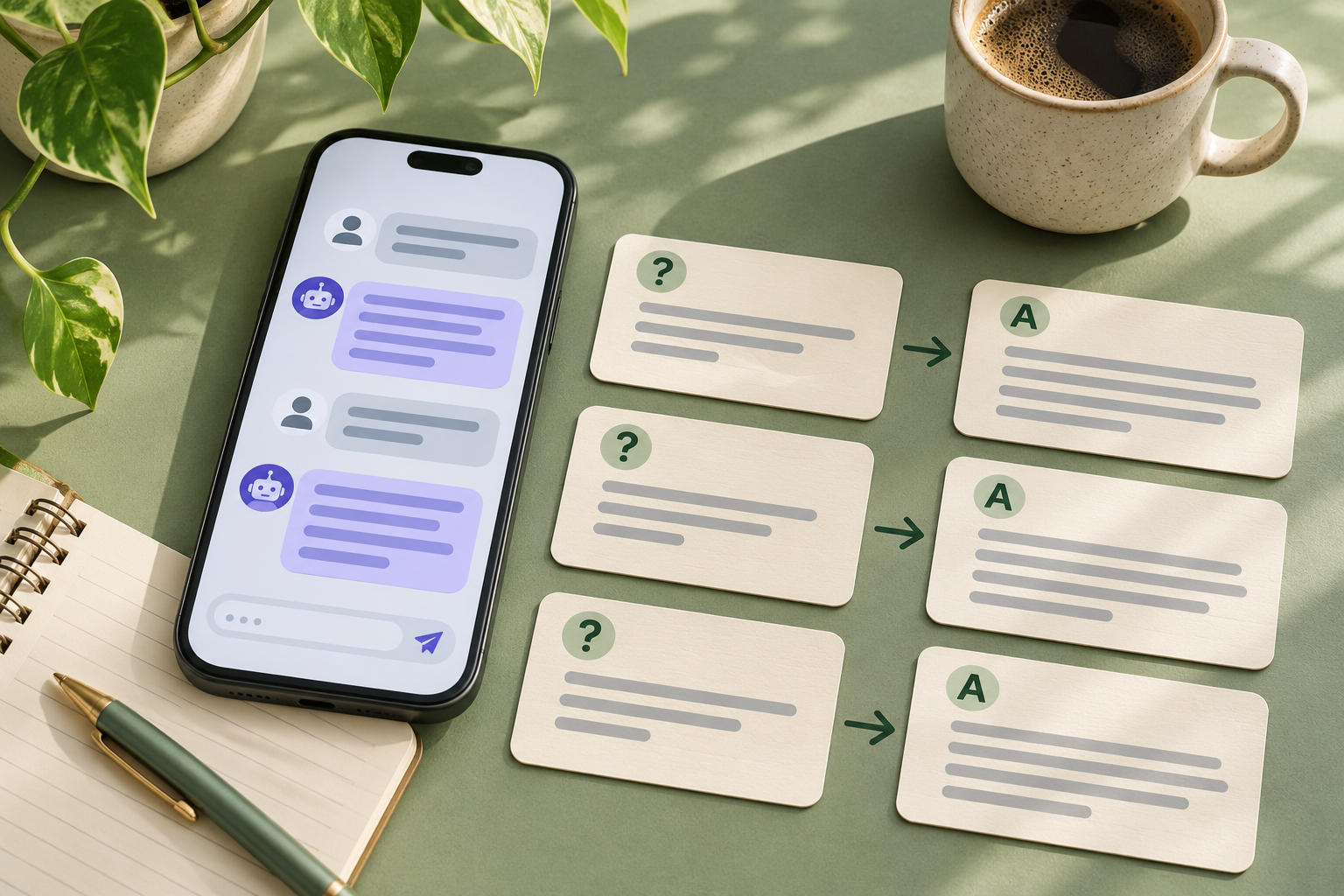
The aim is a manageable exchange: question, attempt, feedback, and another attempt if needed. You decide when the explanation matches your source.
Ask for feedback tied to a specific passage
Encouraging feedback is not the same as an accurate correction. Ask the chat to identify the part of your answer that matches or conflicts with the supplied material.
For example, suppose your answer to the sample question was “A dataset is one recorded case.” You can ask:
Compare my answer with the notes.
Identify the exact term I used incorrectly.
Quote the relevant sentence from my notes, then let me try again.
Do not introduce new definitions from outside the notes.
In this example, the notes distinguish an observation from the collection of observations. That gives you a direct way to inspect the feedback.
If the chat's correction contradicts your textbook or teacher, return to that source. Asking the same chat to confirm its answer is not an independent check.
Turn a weak answer into a targeted follow-up
When you miss a question, another nearly identical question may tell you little about the misunderstanding. Change how you have to use the concept.
After reviewing a definition, ask for an example you can classify:
Give me one short example and ask whether it represents an observation
or a dataset. Wait for my choice and explanation before responding.
Or ask to compare two examples:
Give me two examples that use the terms from my notes differently.
Ask me to explain the distinction. Keep both examples simple and
consistent with the definitions I provided.
The chat may still make a mistake when constructing an example. Keep the original notes nearby so you can decide whether the exercise is useful before spending more time on it.
Keep a short record of what needs another look
A long conversation can obscure the few ideas you actually need to revisit. At the end of a session, ask for a concise record based on the exchange.
List up to three concepts I struggled to explain in this session.
For each, include my main confusion and one question to revisit.
Base the list on my actual answers, not assumptions about my ability.
Do not give me a grade or predict my exam result.
Compare the record with what you remember finding difficult. Save the useful questions in your own notes, then try them again later before reading the answers.
This record is a study aid, not a formal assessment. A fluent explanation or a correct reply in one chat does not establish that you have mastered a topic.
Make a question set you can use away from the chat
You can also ask for questions to copy into a notebook or flashcard tool. Keep the questions and answers separate so you control when to reveal them.
From my notes, create five short practice questions.
Show the questions only. Avoid questions that require facts not present
in the notes. I will ask for an answer key in a separate message.
Check each question before saving it. Remove duplicates and questions that merely ask you to repeat the same definition in slightly different wording. When you request the answer key, verify it against the source material.
Using AI Chat Agent Plus for the workflow
AI Chat Agent Plus is listed for iPhone and iPad. Its publisher describes AI conversations, writing assistance, brainstorming, multilingual support, image analysis, and multiple AI agents.
The practice session above uses ordinary text conversation. Start with a short section you can paste or type, then request the one-question-at-a-time format. Check the current App Store listing and in-app screens for available features and purchase conditions.
These examples do not assume a dedicated quiz mode, document-import feature, persistent study memory, or a particular underlying model. They describe prompts you can try, rather than independently measured results in this application.
You can open AI Chat Agent Plus on the App Store to review the current product information. This is an Alibox-promoted application.
Frequently asked questions
Can AI chat make questions from any notes?
You can ask it to draft questions from text you provide, but inspect the results. Unclear notes, missing definitions, or mistakes in the generated questions can make a practice set less useful. A short, well-defined passage is easier to check than an entire subject.
What if the chat gives the answer immediately?
Restate the format: one question, then wait for your attempt. If the earlier answer spoils that question, ask for a different question about the same concept. Different chat systems may follow the same instruction differently.
Is this a substitute for a teacher or textbook?
Use your course material and teacher's guidance as the reference. The chat can help you draft exercises and discuss your attempts, but its feedback can be incorrect and it does not know your course requirements unless you provide them.
Where does the prompting approach come from?
The examples in this article were written for this guide. The general ideas of clear instructions, constraints, and response formats are also described in Google's prompt design strategies. That documentation concerns Google's models; it is not evidence of a particular learning outcome or of this app's performance.